

Insight into the resilience of local food systems—variability driven by climate, conflict, and food price shocks—is critical for the treatment and prevention of child acute malnutrition.
We use a combination of latent class mixed modeling and time-to-event analysis to develop and test a measure of resilience that is outcome-based, sensitive to specific shocks and stressors, and captures the enduring effects of how frequently and severely children face the risk of acute malnutrition.
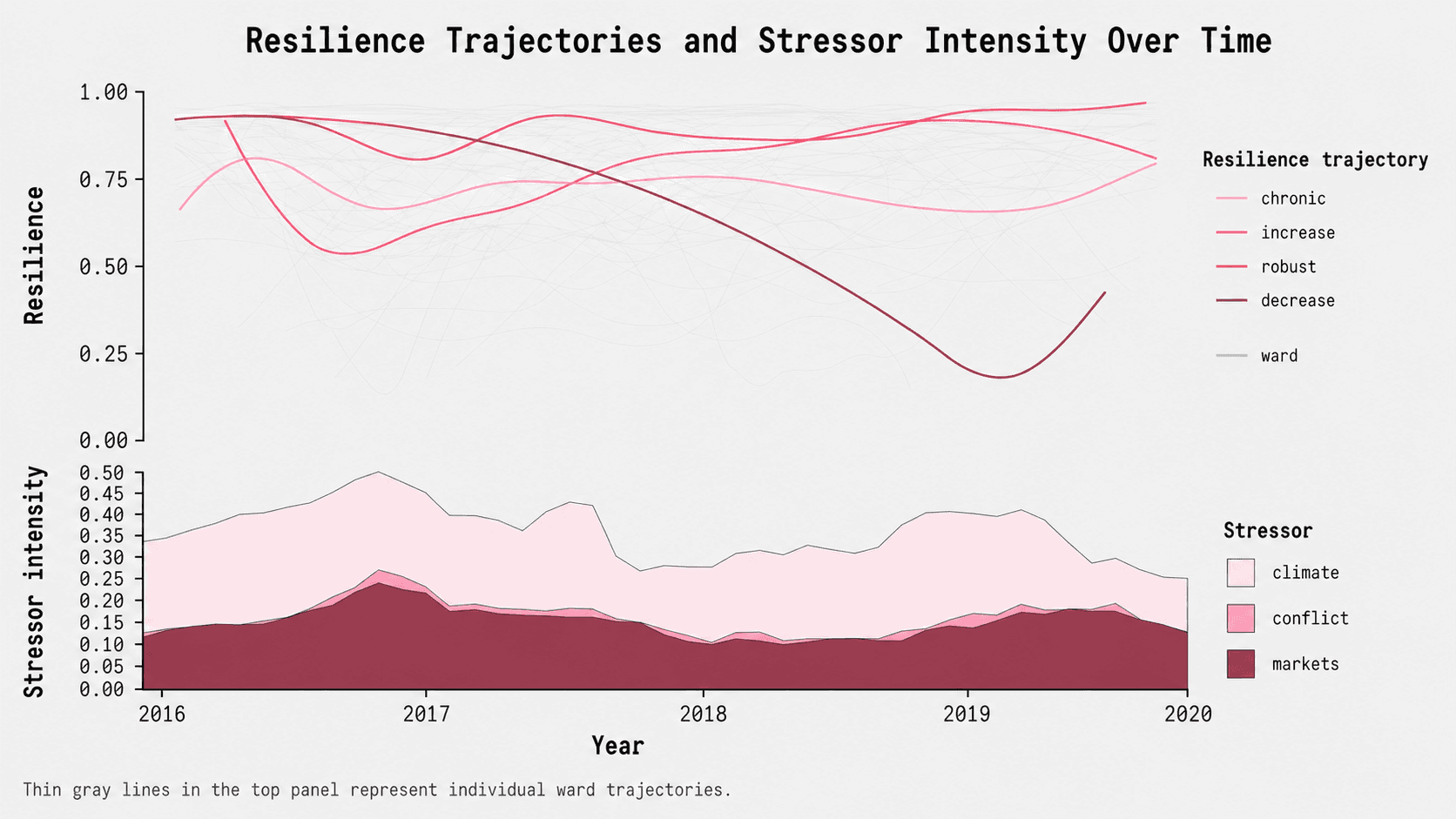
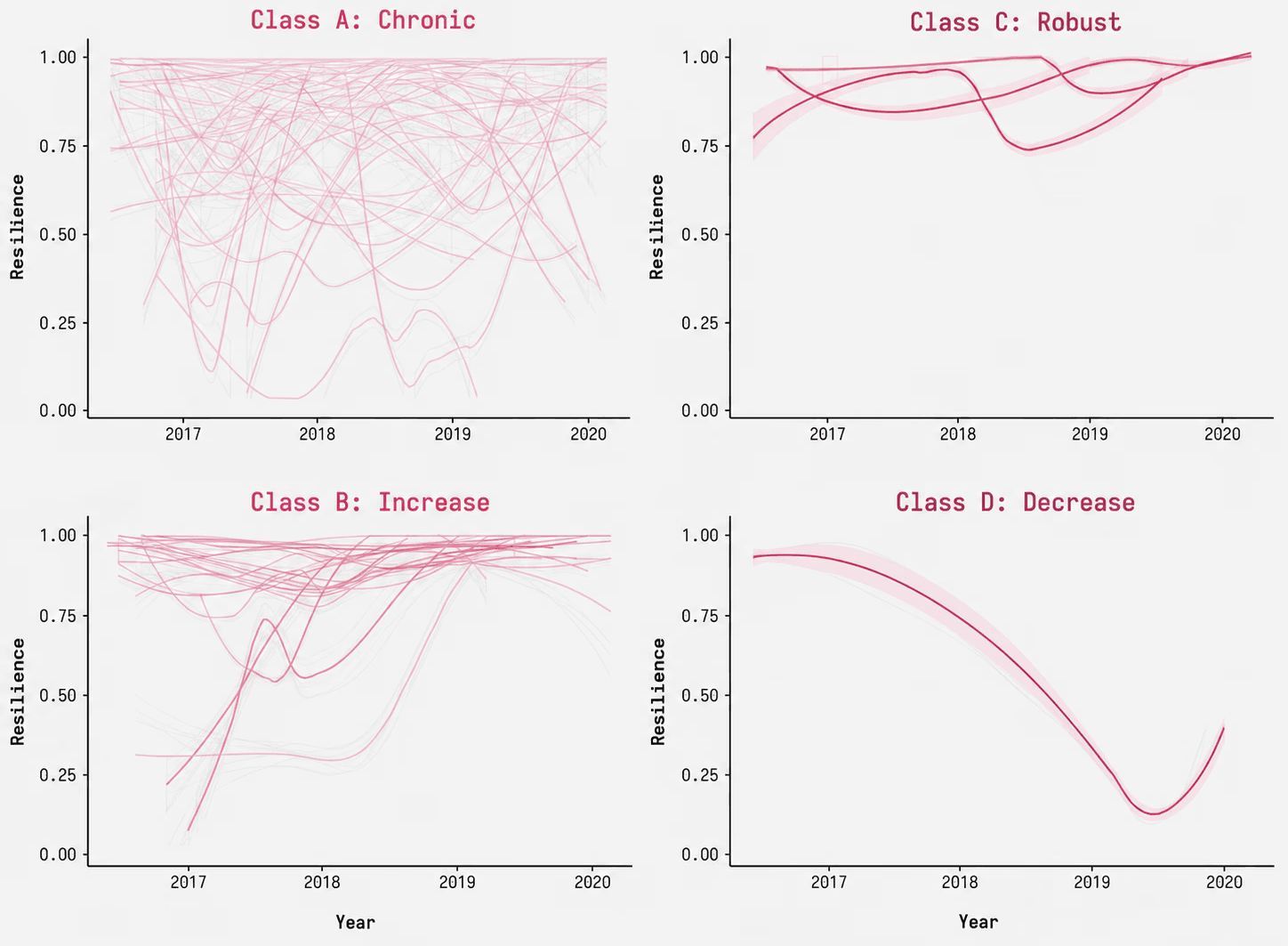
Harnessing a high-resolution longitudinal dataset with anthropometric information on 5,597 Kenyan households for the 2016–20 period, we identify resilience trajectories for 141 wards across Kenya. These trajectories—characterized by variation in the duration and severity of episodes of acute malnutrition—are associated with differential risk: (1) some 57% of wards exhibit an increasing trajectory—high household risk despite growing resilience; (2) 39% exhibit chronic characteristics—showing no real signs of recovery after an episode of crisis; (3) 3% exhibit robust characteristics—low variability with low-levels of individual household risk; whereas (4) 1% show a steady decrease in resilience—associated with high levels household risk.
Our findings highlight the importance of measuring resilience at the ward-level in order to better understand variation in the nutritional status of rural households.AI as a Design Partner
Artificial intelligence will no longer just automate small tasks like resizing images. AI will act as a co-designer, analyzing data, predicting user intent, and generating layouts optimized for both aesthetics and performance. Designers will shift from pushing pixels to setting rules and curating systems. A single website could automatically adapt its typography, imagery, and even tone of voice to suit each visitor.
With the growth of AR and VR, web design will not be limited to flat screens. Websites may become three-dimensional spaces you can explore, similar to walking through a gallery or store. Interfaces will be spatial, navigated by gestures, gaze, or voice rather than clicks. This will require new design languages, blending architecture, storytelling, and interaction design.
Today, personalization is mostly limited to recommendations or content filters. In the future, entire web experiences may be generated in real time for each individual. Fonts, navigation patterns, and interface density could all shift based on user preferences, accessibility needs, or even emotional states detected by sensors. The web will feel less like a single site and more like a living organism responding to its visitor.
As awareness of digital carbon footprints grows, web design will embrace sustainability. Lightweight code, efficient animations, and optimized media will become a priority. Minimalist aesthetics will align with this trend, stripping away clutter not just for visual clarity but also for environmental responsibility.

Other Posts
[05]
2026 | Frontiers in Public Health
2023 | Frontiers in Sustainable Food Systems
2023 | Humanities and Social Sciences Communications


Other Posts
[05]
2026 | Frontiers in Public Health
2023 | Frontiers in Sustainable Food Systems
2023 | Humanities and Social Sciences Communications
Other Posts
[05]
Other Posts
2026 | Frontiers in Public Health
2023 | Frontiers in Sustainable Food Systems
2023 | Humanities and Social Sciences Communications
Insight into the resilience of local food systems—variability driven by climate, conflict, and food price shocks—is critical for the treatment and prevention of child acute malnutrition.
We use a combination of latent class mixed modeling and time-to-event analysis to develop and test a measure of resilience that is outcome-based, sensitive to specific shocks and stressors, and captures the enduring effects of how frequently and severely children face the risk of acute malnutrition.
Harnessing a high-resolution longitudinal dataset with anthropometric information on 5,597 Kenyan households for the 2016–20 period, we identify resilience trajectories for 141 wards across Kenya. These trajectories—characterized by variation in the duration and severity of episodes of acute malnutrition—are associated with differential risk: (1) some 57% of wards exhibit an increasing trajectory—high household risk despite growing resilience; (2) 39% exhibit chronic characteristics—showing no real signs of recovery after an episode of crisis; (3) 3% exhibit robust characteristics—low variability with low-levels of individual household risk; whereas (4) 1% show a steady decrease in resilience—associated with high levels household risk.
Our findings highlight the importance of measuring resilience at the ward-level in order to better understand variation in the nutritional status of rural households.AI as a Design Partner
Artificial intelligence will no longer just automate small tasks like resizing images. AI will act as a co-designer, analyzing data, predicting user intent, and generating layouts optimized for both aesthetics and performance. Designers will shift from pushing pixels to setting rules and curating systems. A single website could automatically adapt its typography, imagery, and even tone of voice to suit each visitor.
With the growth of AR and VR, web design will not be limited to flat screens. Websites may become three-dimensional spaces you can explore, similar to walking through a gallery or store. Interfaces will be spatial, navigated by gestures, gaze, or voice rather than clicks. This will require new design languages, blending architecture, storytelling, and interaction design.
Today, personalization is mostly limited to recommendations or content filters. In the future, entire web experiences may be generated in real time for each individual. Fonts, navigation patterns, and interface density could all shift based on user preferences, accessibility needs, or even emotional states detected by sensors. The web will feel less like a single site and more like a living organism responding to its visitor.
As awareness of digital carbon footprints grows, web design will embrace sustainability. Lightweight code, efficient animations, and optimized media will become a priority. Minimalist aesthetics will align with this trend, stripping away clutter not just for visual clarity but also for environmental responsibility.
Other Posts
[05]
2026 | Frontiers in Public Health
2023 | Frontiers in Sustainable Food Systems
2023 | Humanities and Social Sciences Communications
Other Posts
[05]
2026 | Frontiers in Public Health
2023 | Frontiers in Sustainable Food Systems
2023 | Humanities and Social Sciences Communications
Other Posts
[05]
Other Posts
2026 | Frontiers in Public Health
2023 | Frontiers in Sustainable Food Systems
2023 | Humanities and Social Sciences Communications
Insight into the resilience of local food systems—variability driven by climate, conflict, and food price shocks—is critical for the treatment and prevention of child acute malnutrition.
We use a combination of latent class mixed modeling and time-to-event analysis to develop and test a measure of resilience that is outcome-based, sensitive to specific shocks and stressors, and captures the enduring effects of how frequently and severely children face the risk of acute malnutrition.
Harnessing a high-resolution longitudinal dataset with anthropometric information on 5,597 Kenyan households for the 2016–20 period, we identify resilience trajectories for 141 wards across Kenya. These trajectories—characterized by variation in the duration and severity of episodes of acute malnutrition—are associated with differential risk: (1) some 57% of wards exhibit an increasing trajectory—high household risk despite growing resilience; (2) 39% exhibit chronic characteristics—showing no real signs of recovery after an episode of crisis; (3) 3% exhibit robust characteristics—low variability with low-levels of individual household risk; whereas (4) 1% show a steady decrease in resilience—associated with high levels household risk.
Our findings highlight the importance of measuring resilience at the ward-level in order to better understand variation in the nutritional status of rural households.AI as a Design Partner
Artificial intelligence will no longer just automate small tasks like resizing images. AI will act as a co-designer, analyzing data, predicting user intent, and generating layouts optimized for both aesthetics and performance. Designers will shift from pushing pixels to setting rules and curating systems. A single website could automatically adapt its typography, imagery, and even tone of voice to suit each visitor.
With the growth of AR and VR, web design will not be limited to flat screens. Websites may become three-dimensional spaces you can explore, similar to walking through a gallery or store. Interfaces will be spatial, navigated by gestures, gaze, or voice rather than clicks. This will require new design languages, blending architecture, storytelling, and interaction design.
Today, personalization is mostly limited to recommendations or content filters. In the future, entire web experiences may be generated in real time for each individual. Fonts, navigation patterns, and interface density could all shift based on user preferences, accessibility needs, or even emotional states detected by sensors. The web will feel less like a single site and more like a living organism responding to its visitor.
As awareness of digital carbon footprints grows, web design will embrace sustainability. Lightweight code, efficient animations, and optimized media will become a priority. Minimalist aesthetics will align with this trend, stripping away clutter not just for visual clarity but also for environmental responsibility.
Other Posts
[05]
2026 | Frontiers in Public Health
2023 | Frontiers in Sustainable Food Systems
2023 | Humanities and Social Sciences Communications
Other Posts
[05]
2026 | Frontiers in Public Health
2023 | Frontiers in Sustainable Food Systems
2023 | Humanities and Social Sciences Communications
Other Posts
[05]
Other Posts
2026 | Frontiers in Public Health
2023 | Frontiers in Sustainable Food Systems
2023 | Humanities and Social Sciences Communications